Last updated November 18, 2026
Home Addition Contractor Warning Signs Every Homeowner Should Know
A contractor who asks for more than 10% upfront before permits are pulled isn’t just aggressive. In Nevada, it’s a licensing violation. Most homeowners don’t know that, and most contractors are counting on it. The dangerous ones don’t look sketchy either. They look busy, confident, and cheap, which is exactly why the early flags slide right past you until you’re $40,000 in with no recourse. This guide teaches pattern recognition, not just a checklist. You’ll learn the deal-breakers, the yellow flags worth a conversation, the Nevada Revised Statutes caps on deposits, and the three questions that surface trouble in 90 seconds. If you’re planning an addition in Enterprise, read this before you sign anything.
Quick Answer
The biggest home addition contractor warning signs are refusing to put a price in writing before demo day, asking for a deposit above Nevada’s legal cap before permits are pulled, working without an NSCB license, and offering no verifiable business address or reviews. Any one of these is enough to walk away. A contractor who won’t commit to a written scope and price is the single most reliable predictor of a budget blowout.
Table of Contents
- Deal-Breaker Red Flags vs. Yellow Flags Worth a Conversation
- What Nevada Law Actually Says About Deposits and Down Payments
- The Verbal Estimate Disappearing Act
- Digital Warning Signs Most Homeowners Miss
- The Three-Question Script That Surfaces Trouble in 90 Seconds
- What a Legitimate Walkthrough Looks Like in Enterprise
- Contract Terms That Protect You (and the Ones That Don’t)
- Common Mistakes to Avoid
Deal-Breaker Red Flags vs. Yellow Flags Worth a Conversation
Not every warning sign means run. Some mean ask a follow-up question. The problem is homeowners treat all flags the same, so they either ignore serious ones or walk away from a good contractor over a small crew. Here’s how we separate them.
Deal-breakers are things that make a project legally risky or leave you with no recourse:
- No written contract. A handshake addition is unenforceable. If something goes wrong, you have nothing to stand on.
- No NSCB license. Nevada’s State Contractors Board exists so you can verify a contractor before a single dollar changes hands. An unlicensed contractor in Enterprise can’t legally pull permits on your addition.
- Cash-only requests. Cash leaves no paper trail. It also usually means the contractor is dodging taxes, insurance, or licensing, and you absorb that risk.
- Deposit above the legal cap. More on the exact numbers below, but if they ask for half the project upfront before permits, that’s a legal problem, not a style preference.
- A price that only exists verbally. If it’s not on paper, it doesn’t exist, and it will change.
Yellow flags deserve a question, not an exit. A newer company with a small crew can be excellent. A contractor who’s a little disorganized on email may still build a great addition. The test is whether they answer your questions clearly and put their answers in writing. A contractor who gets defensive when you ask about licensing or a written quote is telling you something. That defensiveness, not the small crew, is the real flag.
What Nevada Law Actually Says About Deposits and Down Payments
Nevada Revised Statutes cap how much a contractor can collect upfront before work begins, and the cap depends on the size of the project. For most residential work, a contractor cannot demand more than 10% of the contract price, or $1,000, whichever is less, as a down payment before the project starts. For larger projects where the total exceeds $250,000, a contractor may request a down payment of up to 10% of the contract price. Knowing these numbers changes the conversation from a gut feeling into a citation.
Why does this matter at the kitchen table? Because the deposit is where the leverage lives. A contractor holding a large deposit before permits are pulled can afford to get slow, go quiet, or spend your money on another job. A contractor working within the legal cap has the same incentive you do: get permits, get moving, get paid as milestones clear.
Two things to check alongside the deposit cap:
- Permits pulled before money changes hands. In Enterprise, an addition needs permits, and permits come from a licensed contractor. If they want a big deposit before they’ll pull permits, ask why.
- A written payment schedule tied to milestones. Not “half now, half when done.” Milestone payments (foundation, framing, rough-in, finish) keep the risk shared, not stacked on your side.
Homeowners who cite the statute instead of arguing about trust get a much clearer reaction. The ones who are doing it right aren’t bothered by the question. The ones who aren’t tend to get uncomfortable fast.
The Verbal Estimate Disappearing Act
If you remember one section of this guide, make it this one. The single most predictive warning sign of a budget blowout is a contractor who refuses to commit costs to paper before demo day. They’ll give you a number at the kitchen table. They’ll nod at your questions. Then the number quietly grows once the walls are open, because there was never a fixed price to begin with. This is how a $90,000 addition becomes $140,000, one “unforeseen condition” at a time.
In our experience, the disappearing verbal estimate almost always means one of three things:
- They don’t know their real costs. A contractor who can’t produce a line-item number hasn’t done the takeoff. You’re the one who finds out they were guessing.
- They’re planning to change-order you. A low verbal number wins the job. The real profit lives in the change orders after demo.
- They’re hoping you won’t ask. Many homeowners don’t, because asking feels confrontational. It isn’t. It’s the most reasonable request you’ll make all year.
What a written price should include: a scope of work that names the materials, a line-item cost breakdown, an allowance schedule for anything that could flex (tile, fixtures, windows), and a clear statement of what’s excluded. Write “allowance” in the margin and ask what happens if you go over. A good contractor will walk you through it calmly. That written price before work starts is the whole point of the home addition contractor in Enterprise process we run, and it’s the difference between pricing a project and discovering it.
Digital Warning Signs Most Homeowners Miss
Most red flags now live on your phone before a contractor ever knocks. A few minutes of checking catches things a site visit won’t.
- No physical business address. A PO box alone is a yellow flag; a website with no address anywhere is a red one. Legitimate contractors have a place you can look up.
- Reviews you can’t verify. One glowing five-star review from an account with no history means nothing. Look for a spread of reviews over time, and read the one and two-star ones first.
- Photos that belong to someone else. Reverse-image-search a few of their project photos. Stock images and photos lifted from other contractors’ portfolios are common in this space, and they’re easy to catch.
- No license lookup match. Search the business and the name on the NSCB site. If the license doesn’t match the person at your table, that’s a conversation.
- A phone that goes to voicemail. This one is quieter than the rest, but you’ll notice it. Call twice at different times of day. A contractor who can’t answer before the sale is a contractor who definitely won’t answer mid-build.
This is one reason we lean on prefab ADU brands like Abodu, Cover, and Dvele for certain projects: you can research those products independently, on your own time, and see exactly what you’re buying instead of taking a contractor’s word for it. The same instinct applies to the contractor. Verify everything you can from your phone before you commit to anything.
The Three-Question Script That Surfaces Trouble in 90 Seconds
You don’t need a long interrogation. Three questions on the first call will tell you most of what you need to know. Ask them, then listen to how the contractor answers. The words matter less than whether the answers are fast, specific, and written down.
- “Can you send me a written price and scope before any work starts, and can you tell me what’s included and what isn’t?” Watch for hedging. “We’ll figure that out later” or “I’ll get you a ballpark” is the disappearing act starting early.
- “What’s your NSCB license number, and what’s the deposit you’ll ask for?” A good contractor answers both without flinching. If they can’t give a clear number on the deposit, or dodge the license question, that’s your answer.
- “Who pulls the permits, and can you show me photos when the work is done?” The right contractor pulls the permits themselves and expects you to ask for proof. Photos at each stage (before, during, after) should be business as usual, not a special request.
If all three answers are clear, you probably don’t have a problem. If any answer is vague, defensive, or delayed, you’ve saved yourself weeks. The best contractors welcome these questions because they’re what a real plan sounds like. For a broader look at what the build itself involves, our ADU builders in Enterprise guide walks through the phases from permit to finish.
What a Legitimate Walkthrough Looks Like in Enterprise
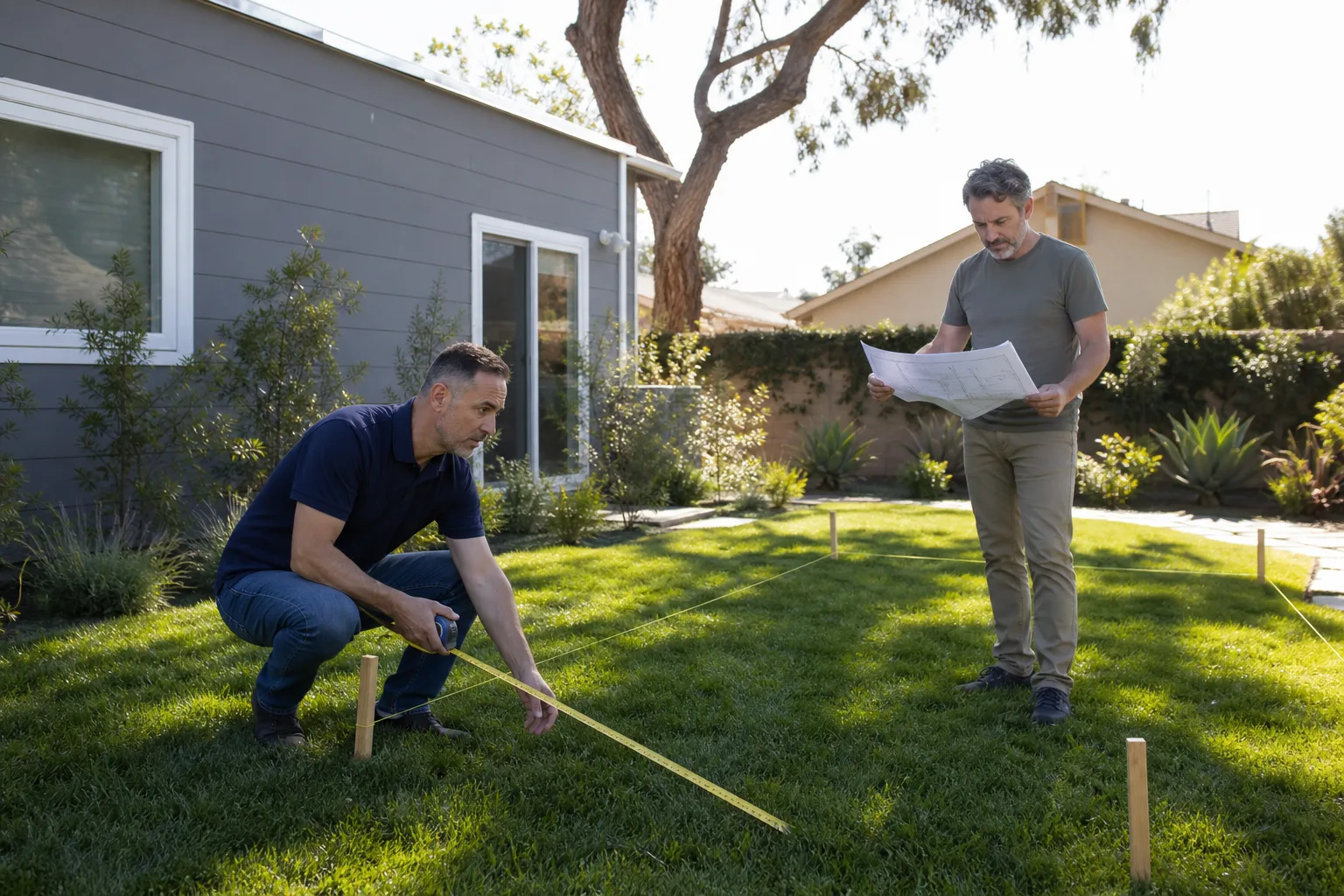
The walkthrough is where a lot of homeowners get charmed, so it’s worth knowing what a real one looks like. A legitimate contractor walks the site, measures, asks about setbacks, utility locations, and access, and talks about how the addition ties into your existing roofline and slab. They’ll mention the desert climate, because an addition here has to handle summer heat and the occasional monsoon-grade rain.
Here’s what you should see during a real walkthrough:
- Questions, not just answers. A contractor who only talks and never asks isn’t planning. They’re selling.
- Setback and zoning awareness. A setback is the required distance from your property line. In Enterprise, that distance matters before anyone draws a plan, and a good contractor brings it up early.
- Clear scope boundaries. They should name what’s included (foundation, framing, finishes, permit fees) and what isn’t (landscaping, some utility connections), out loud, not in fine print.
- Prefab vs. site-built talk. For additions and ADUs, an honest contractor explains both options. Prefab panels arrive built in a factory and assembled on site, which can mean tighter timelines and predictable costs. Site-built is traditional construction, stick by stick. Each has trade-offs, and you should hear them from someone neutral.
- No pressure to sign today. A real contractor will still be there next week.
If you’re comparing options for a smaller addition, our room addition contractor in Enterprise page covers how scope and cost shift for single-room projects.
Contract Terms That Protect You (and the Ones That Don’t)
The contract is where the project either gets safeguarded or gets exposed. Read it before you sign, line by line. If something feels off, ask for it in writing. A contractor who won’t put a term on paper isn’t a contractor you want building on your property.
Terms that protect you:
- A written price with a line-item breakdown. Not a lump sum with a “subject to change” note underneath.
- A payment schedule tied to milestones. Foundation, framing, rough-in, finishes. You pay for completed work, not promises.
- A clear change-order process. Any addition should require a written change order both people sign before the work is done. No verbal “we’ll add that” during the build.
- A workmanship warranty with specific terms. Ours is the 365-Day Done Right Promise on every project: if the work isn’t right within a full year, we make it right. That commitment belongs in writing, and any contractor worth hiring puts their equivalent on paper.
- Permit and inspection responsibility spelled out. The contractor pulls the permits and passes the inspections. That should be a contract term, not a courtesy.
Terms that should make you pause: “spec materials subject to availability” with no allowance, vague completion language (“approximately,” “as soon as possible”), an arbitration clause that strips your right to pursue a claim, and a clause absolving the contractor of responsibility for delays caused by “weather or other events.” Some of these are normal, but the contract should name limits and remedies, not just protections for one side. For a broader look at how this reads across projects, our Benson ADU Builders Enterprise home page shows how the written-price approach applies to any build.
Common Mistakes to Avoid
- Paying a big deposit before permits are pulled. A deposit above Nevada’s legal cap in exchange for a promise is a common mistake. The contract should tie payment to permits and milestones, not to a handshake.
- Accepting a verbal estimate. The number sounds great at the kitchen table, but a verbal price in Enterprise is a number with no memory. Get it in writing or don’t proceed.
- Not looking up the license. The NSCB lookup takes two minutes. Skipping it means your entire project rides on trust you haven’t verified.
- Ignoring the “no address” website. A contractor with no physical location and no verifiable reviews is a contractor you’ll struggle to find if something goes wrong. Check before you commit.
- Signing a contract with vague completion language. “Approximately” and “as soon as possible” are how a 16-week addition becomes a year-long project with no penalty.
- Not asking for before-and-after photos. A contractor who photographs their work at each stage holds themselves accountable. A contractor who can’t produce photos of past projects is asking you to trust the unverifiable.
- Choosing the cheapest bid. The lowest number on the table is almost always the one that grows the most after demo. Compare written scopes, not totals.
When to Call a Professional
Call a professional contractor before you’ve signed anything and before you’ve paid anything. If any of the following is true, it’s time to make a call and get an honest second opinion: a contractor wants a deposit above the legal cap before permits, refuses to put a price in writing, dodges the NSCB license question, or has no verifiable business address. The same applies if you’re already in a project and the change orders are stacking up with no written trail. In Enterprise, an addition is a major investment, and getting it priced and permitted correctly from the start saves you from the worst-case scenario down the road. Benson ADU Builders Enterprise offers free estimates in Enterprise. Call (844) 980-0541 to schedule a walkthrough and get a written price before any work starts.
Frequently Asked Questions
A contractor who won’t put a price in writing before demo day is the biggest red flag, because it’s the most reliable predictor of a budget blowout. If there’s no written scope and no line-item price, every “unforeseen condition” turns into a change order you didn’t plan for. Call (844) 980-0541 for a free written estimate and see what a real price looks like.
For most residential projects, a Nevada contractor can’t request more than 10% of the contract price, or $1,000, whichever is less, as a down payment before work begins. For projects over $250,000, the cap rises to 10% of the contract price. If someone asks for half the project upfront before pulling permits, that’s a licensing problem, not a negotiation.
Use the Nevada State Contractors Board lookup: search the company name and the name of the person you’re dealing with, and confirm the license status, classification, and that it matches the business you’re hiring. It takes a couple of minutes and it’s the single most-consequential check you’ll make. If anything doesn’t match, ask before you sign anything.
Not on its own. A smaller crew or a newer company can deliver excellent work, and it’s often a yellow flag worth a conversation rather than a reason to walk. The real test is whether they answer your questions clearly and put the answers in writing. Defensiveness about licensing, permits, or quotes is the actual warning sign.
A written estimate should include a full scope of work, a line-item cost breakdown, allowances for materials that could flex (tile, windows, fixtures), a clear statement of exclusions, a payment schedule tied to milestones, and a completion timeline with specifics. If any of those pieces are missing, ask. A legitimate contractor will supply them without pushback. Call (844) 980-0541 to see a written price before work starts.
A prefab addition uses panels or modules built in a factory and assembled on site, which often means tighter schedules and predictable costs. Site-built is traditional construction, built stick by stick at your property. Both can be right for different projects. Prefab brands like Abodu, Cover, and Dvele give you products you can research independently, while site-built offers more flexibility on layout. An honest contractor will walk you through both before you choose.
The Bottom Line
The dangerous contractors don’t look dangerous. They look busy, confident, and cheap, and the warning signs are quiet: a verbal estimate that never becomes paper, a deposit above Nevada’s legal cap, a license that doesn’t check out, a website with no address behind it. Learn the pattern, and you’ll catch trouble in the first conversation instead of the fortieth week. Ask the three questions. Read the contract. Insist on a written price before work starts, and hold the deposit to the statute. Do that, and you walk into your addition with the one thing that matters most: recourse.
If you’re ready to price a project the right way, call Benson ADU Builders Enterprise at (844) 980-0541 for a free estimate. You’ll get a written price before any work starts, a live person on the phone whenever you call, and the 365-Day Done Right Promise behind every project.
Written by the team at Benson ADU Builders Enterprise.