Last updated November 18, 2026
DIY vs Professional ADU: The Enterprise Homeowner’s Decision Guide
Most DIY-versus-pro comparisons assume the only variable is skill. In Enterprise, it isn’t. Clark County requires a licensed contractor on record for permitted ADU work, and an owner-builder who goes it alone can trigger owner-occupancy restrictions that limit how you rent the unit for up to five years. That single rule changes the ROI math before you buy a single board. This guide walks through Nevada’s owner-builder exemption, the Clark County restrictions that modify it, the real hidden costs of DIY, and a plain decision framework built on timeline, cash, and intended use.
Quick Answer
For most Enterprise homeowners, hiring a licensed professional wins: a DIY ADU is legally possible under Nevada’s owner-builder exemption, but Clark County zoning can tie an owner-built unit to owner-occupancy for up to five years, killing rental income. Add the cost of permit delays, failed inspections, and mandatory licensed phases, and DIY rarely saves what it appears to. Unless you have unlimited time, deep trade experience, and no plans to rent, a licensed contractor is the lower-risk path. Call (844) 980-0541 for a free estimate.
Table of Contents
- What Nevada’s Owner-Builder Exemption Actually Allows
- How Clark County’s ADU Restrictions Modify the Exemption
- The Real Cost of DIY: Materials Aren’t the Whole Number
- Three Phases Where a Licensed Professional Is Legally Required
- The Insurance and Liability Gap Owner-Builders Carry
- A Decision Framework: Timeline, Cash, and Intended Use
- Where Prefab Fits In for Enterprise Homeowners
- Common Mistakes to Avoid
- When to Call a Professional
- Frequently Asked Questions
What Nevada’s Owner-Builder Exemption Actually Allows
Nevada lets a homeowner act as their own contractor on a residence they will personally occupy. That’s the owner-builder exemption. In plain English: you can pull the permits in your own name, hire subcontractors directly, and skip a general contractor on paper. It sounds like the DIY door is wide open.
It isn’t as wide as it looks. The exemption is narrow, and it comes with conditions that trip up homeowners in Enterprise who read the statute but not the county layer underneath it. The exemption applies to your primary residence, meaning the unit you’ll live in, not a property you hold for income. It also shifts general-contractor liability onto your shoulders. When something fails inspection or a subcontractor walks off the job, there’s no GC license for the county to suspend. That leverage belongs to you, and you’ll be the one absorbing the consequences.
A few practical facts Enterprise homeowners should know before assuming they’ll self-build:
- The exemption is personal. It dies if you sell the property mid-project or convert it to a rental before completion.
- You become the responsible party for warranty claims a licensed contractor would otherwise carry.
- Subcontractors you hire directly still need their own licenses and permits for their scopes.
- Workforce coverage and general liability shift to you, not to the trades you bring on.
- County inspectors treat an owner-builder job with the same scrutiny as any other permitted project.
The exemption exists. It just doesn’t lift the safety net the way people assume. For Enterprise homeowners planning to rent the finished ADU, that distinction is the whole ballgame.
How Clark County’s ADU Restrictions Modify the Exemption
Here’s where the Enterprise decision diverges from a general Nevada answer. Clark County’s zoning code for unincorporated areas adds owner-occupancy requirements to certain ADU approvals. In plain terms, the county may require that you live in either the main house or the ADU itself as a condition of approval. If you planned to build the unit purely for rental income, that condition can lock you out of the rental market for up to five years.
That’s a zoning rule, not a building-code rule, and it’s why owners who research the statute alone get blindsided. The permit office enforces it. When it applies, your ADU becomes a family-housing asset, not an income asset, for the duration of the restriction.
What that means in practice:
- If the ADU is for a parent or adult child, the owner-occupancy condition often costs you nothing.
- If the ADU is an income play, an owner-built unit carrying the restriction can erase years of projected rent.
- A licensed contractor’s permitted build doesn’t automatically remove zoning conditions, but a pro who works in Enterprise regularly knows how to structure the application and which submittals the county wants to see.
- Deed restrictions and HOA rules stack on top of county zoning, and Enterprise has plenty of both in newer subdivisions.
Run your intended use against the county’s requirement before you design anything. This is the single step that most changes the DIY-versus-pro answer. Our ADU Builders in Enterprise team runs that check as part of a free estimate, and it’s worth the call even if you plan to self-build.
The Real Cost of DIY: Materials Aren’t the Whole Number
DIY comparisons almost always put material costs on one side and a contractor’s price on the other. That’s not the comparison. Here’s what the honest line-item looks like for a typical Enterprise ADU:
- Materials at retail: $95,000-$165,000 for a detached one-bedroom in the 500-700 square foot range, depending on finishes and site work.
- Licensed subs you still must hire (electrical, plumbing, structural): $18,000-$42,000.
- Permit fees and plan review: $4,000-$12,000 in Clark County for a project this size, before corrections.
- Plan revision cycles: $2,000-$8,000 per round when the county sends comments back, plus 3-6 weeks added to the timeline.
- Failed inspection corrections: $1,500-$6,000 per cycle, and some projects hit three or four.
- Your own time: 300-500 hours of coordination if you manage it yourself, which is a real cost at any hourly rate.
The materials savings look like $40,000 to $70,000 on paper. Once delays, corrections, and 6-18 months of extended timeline (during which you’re paying the mortgage you already had) get folded in, the gap often narrows to a wash. Sometimes it reverses. We’ve seen Enterprise homeowners spend more on a DIY ADU than a quoted build because the third inspection cycle ran their contingency to zero.
A written price before work starts, which is standard on every project we quote, exists precisely so you can put it next to your DIY number and see whether the savings are real. Our Home Addition Contractor in Enterprise team writes those quotes line by line.
Three Phases Where a Licensed Professional Is Legally Required
Even under the owner-builder exemption, three phases require licensed professionals in Nevada. You cannot legally self-perform these, no matter how skilled you are. Plan for them in your DIY budget from day one.
- Electrical final. All electrical rough-in and final connections must be performed by a licensed electrician and inspected by the county. This isn’t a corner you can cut by doing it yourself and hoping the inspector doesn’t notice; the permit is pulled in the electrician’s name, and the inspection won’t pass without the license on record.
- Plumbing rough-in inspection. The plumbing rough must be inspected before drywall goes up, and the licensed plumber is the party of record on that permit. Anything they find wrong, they’ll bill you to correct before the county ever sees it.
- Structural engineering sign-off. Any ADU with a real structural design – which is every permanent ADU – needs a licensed structural engineer’s stamped drawings and final sign-off. The county won’t issue a certificate of occupancy without it.
There’s a safety reason those three phases are carved out, and it’s not bureaucracy. Electrical work in an ADU carries real fire and shock risk, and a panel the wrong size for a second dwelling can be dangerous in ways you won’t see until something fails. Gas lines and plumbing leaks cause damage that shows up weeks later. Structural failures are the worst case of all. If you’re unsure whether your plan is safe, call a pro before you touch it. This is one place where “we can figure it out” is the wrong instinct.
The Insurance and Liability Gap Owner-Builders Carry
A licensed contractor carries a bond, general liability coverage, and worker’s compensation. That combination is the thing that protects a homeowner when something goes wrong: a fire, a fall, a subcontractor who damages a neighbor’s property. When you owner-build, that coverage is yours to find and pay for. Most standard homeowners policies exclude construction on a residence under active permit, and the gap only becomes obvious when you file a claim and get denied.
For an Enterprise ADU intended for rental, the exposure gets worse. If a tenant is injured by work you self-performed, or by a subcontractor you hired directly, the claim falls on you personally, not on a contractor’s bond. Owner-occupancy restrictions can limit your rental income for up to five years, but they don’t limit your liability during that time. Those are two separate problems, and DIY stacks them.
What a bonded, insured contractor actually eliminates:
- The liability shift. If a sub’s work causes damage, the contractor’s coverage responds, not yours.
- Worker protection. If an uninsured worker is hurt on your site, you’re not the one exposed.
- The warranty burden. A written guarantee on every project means you’re not the last line of defense on your own unit.
- The sub-quality risk. A GC who’s vetted the electrical and plumbing trades puts that vetting in writing.
That’s the real trade. DIY may save on materials; it costs on protection.
A Decision Framework: Timeline, Cash, and Intended Use
Three variables decide this. Score yourself honestly on each, and the answer usually falls out on its own.
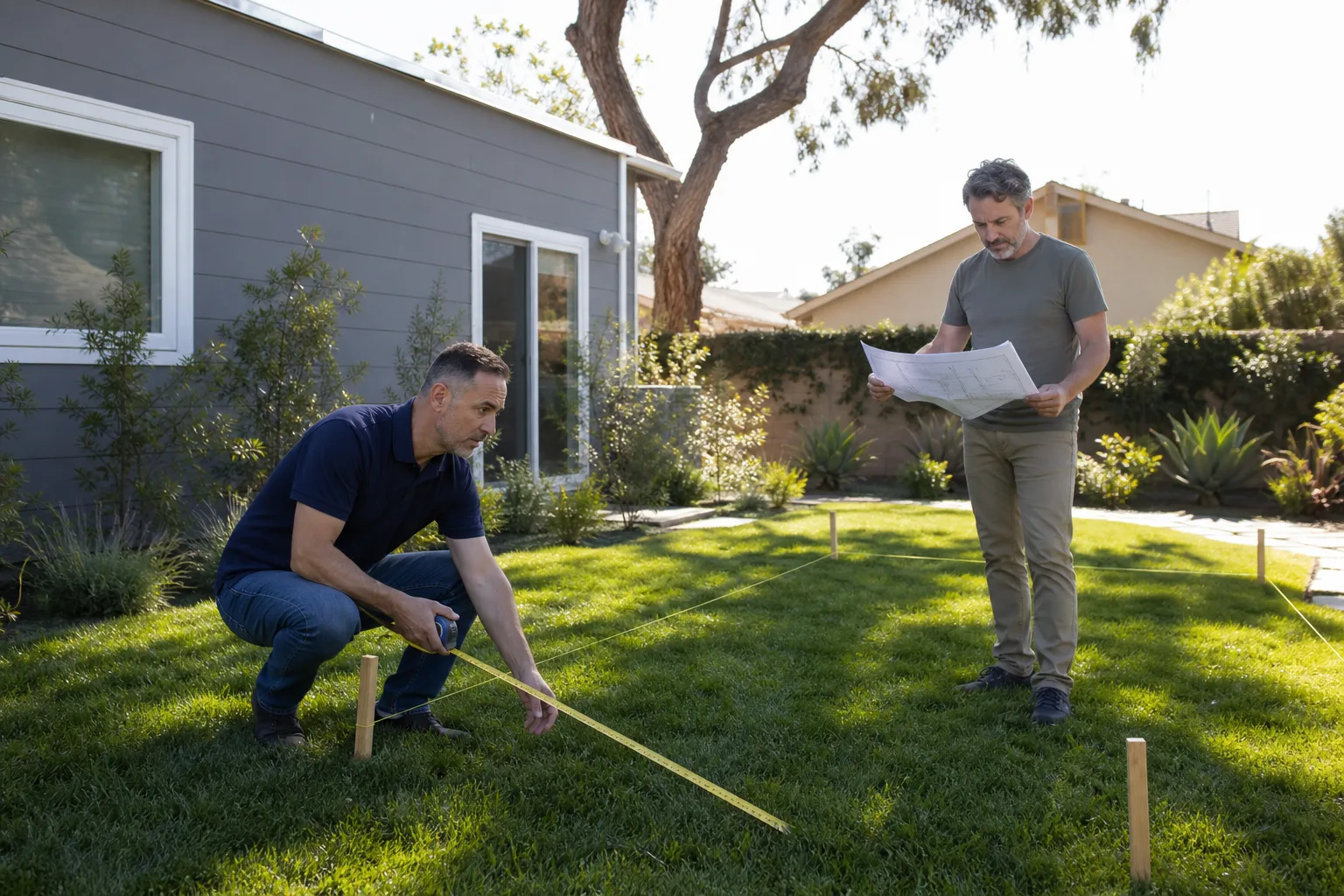
- Timeline flexibility. If you can absorb 12-18 months of permit cycles, inspection corrections, and sub scheduling drama, DIY is feasible. If you need a unit occupied within a year – for a family member, or for rental income you’re counting on – the schedule risk alone points to a pro. A written schedule with a licensed team is the difference between a plan and a hope.
- Available cash. DIY requires more contingency, not less. Budget 25-30% above your materials number to cover corrections and revisions. If you can’t hold that reserve, you’re one failed inspection away from a stalled shell. A contractor’s line-item price fixes that scope before the first shovel turns.
- Intended use. Family housing, workspace, or rental. Rental is the deciding variable in Enterprise because of the owner-occupancy restriction. If the unit needs to generate income inside the five-year window, owner-build ADU zoning risk is usually disqualifying. For family housing, DIY is more defensible – but only if the timeline and reserve are there.
If you pass all three, DIY is a real option and you should pursue it. If you fail on timeline or cash, hire a pro. If you fail on intended use (rental), hire a pro and get the application structured correctly from the start.
Where Prefab Fits In for Enterprise Homeowners
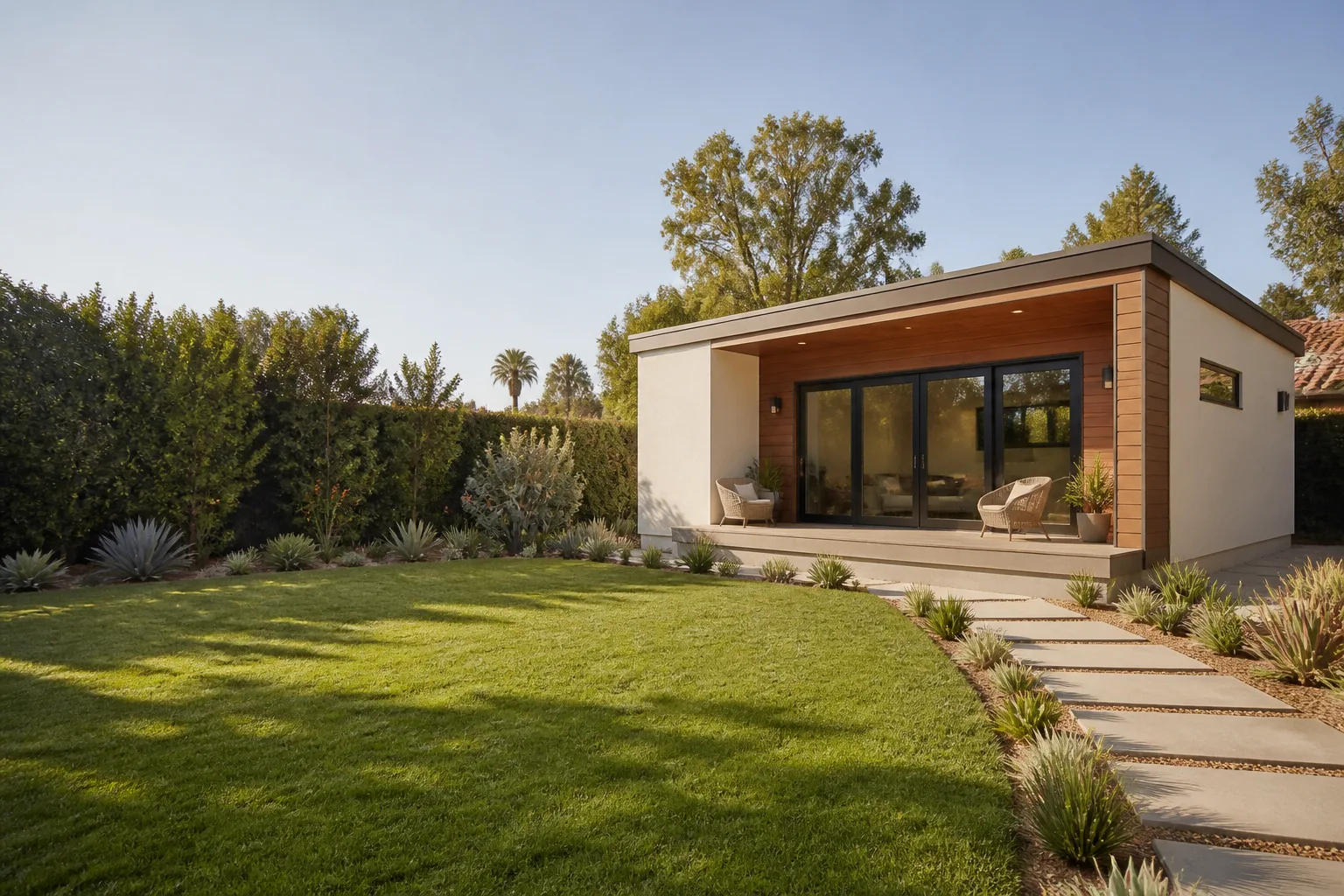
Prefab ADUs change the DIY calculus. A prefab unit – a modular home built in a factory and delivered as panels or modules – compresses the on-site build to weeks instead of months. That reduces the window for permit-cycle and inspection delays, which is the cost that sinks most DIY projects. For Enterprise owners with a tighter timeline, prefab can make the difference between building and not building.
The tradeoff is that most prefab builders require an authorized builder for installation and utility connections. You’re not truly DIY at that point; you’re hiring a contractor to install a prefab you selected. That’s fine, and it often costs less than a full site-built ADU. Brands we build with and source from include Abodu, Cover, Dvele, Mighty Buildings, Boxabl, Plant Prefab, and Tuff Shed, plus James Hardie cladding for the exterior. Homeowners can research each of those names independently, which is exactly the point.
Two things to know in Enterprise if you go prefab:
- Foundation and utility connections still need to meet Clark County code and pass inspection, so the licensed phases don’t disappear.
- Delivery access matters. Some Enterprise lots and HOA-controlled streets have truck-access limits on modules, so verify the site before you buy.
Prefab is the middle path: faster than site-built, more controlled than DIY, and often the most cost-predictable option for a rental-intent ADU. Our Room Addition Contractor in Enterprise team can walk through which brands fit your lot and intended use.
Common Mistakes to Avoid
- Reading the Nevada statute and stopping there. The owner-builder exemption is real, but Clark County’s zoning layer modifies it for ADUs. Homeowners who research at the state level and skip the county layer find out about owner-occupancy restrictions after they’ve bought lumber.
- Budgeting only materials. A $60,000 materials savings doesn’t survive the first two permit-revision cycles and a failed inspection. Budget the corrections, not just the boards.
- Ignoring the owner-occupancy condition because “it won’t apply to me.” In Enterprise, plenty of subdivisions have deed restrictions and HOA rules that layer on top of county zoning. Verify before you design.
- Self-performing electrical or plumbing to save money. Both require a licensed professional on record in Nevada. Doing it yourself isn’t a shortcut; it’s an inspection failure waiting to happen, and a safety risk besides.
- Assuming homeowners insurance covers your active build. Most standard policies exclude construction under permit. Verify coverage before demolition, not after a claim.
- Choosing a prefab without verifying delivery access. Module trucks need clearance and turning radius. A 500-square-foot unit that won’t fit down your street is a very expensive non-starter.
- Treating the timeline as optimistic. Enterprise ADUs that go through corrections typically run 12-18 months on a DIY path. If you need the unit occupied sooner, the DIY number isn’t the number.
When to Call a Professional
Call a pro when any of these is true: your ADU timeline is under a year, your reserve is under 25% of your materials budget, your intended use is rental, or any part of the project involves electrical, plumbing, or structural work you can’t legally self-perform. Also call if the property sits inside an HOA or has deed restrictions you haven’t fully read. Those are the situations where DIY turns into a half-finished shell and a stalled timeline. Benson ADU Builders Enterprise offers free estimates in Enterprise – call (844) 980-0541. Every homeowner gets a written price before any work starts, a 365-Day Done Right Promise, and background-checked, uniformed technicians on every job site. Our technicians have up to 20 years of experience, and we source from the prefab brands above so you can compare before you commit.
Frequently Asked Questions
Yes, in limited form. Nevada’s owner-builder exemption allows you to act as your own contractor on a residence you’ll personally occupy, pulling permits in your own name. But Clark County zoning can require owner-occupancy of the property for up to five years on ADU approvals, and electrical, plumbing, and structural phases still require licensed professionals. For most rental-intent projects in Enterprise, the practical answer is that you can’t build a fully DIY ADU without accepting restrictions that affect your ROI. Call (844) 980-0541 for a free estimate that runs your specific lot against those rules.
Materials for a typical 500-700 square foot detached Enterprise ADU run $95,000-$165,000 at retail, plus $18,000-$42,000 for the licensed electrical, plumbing, and structural work you’re required to hire out. Add $4,000-$12,000 in permit fees, $2,000-$8,000 per plan revision cycle, and $1,500-$6,000 per failed inspection correction, and the DIY number climbs toward a contractor quote fast. A written, line-item contractor price removes the correction risk from your side of the ledger. Call (844) 980-0541 for an exact quote – estimates are free.
Electrical final connection, plumbing rough-in inspection, and structural engineering sign-off. All three are permitted and inspected with the license on record, and none can be self-performed under the owner-builder exemption. That’s not red tape: electrical faults, gas and water leaks, and structural failures are the injuries that send people to the hospital. If any of those phases is outside your expertise, it should be outside your hands.
It can. Clark County’s unincorporated zoning may require owner-occupancy for up to five years as a condition of ADU approval, which limits your ability to rent during that window. If the ADU is for a parent or adult child, that costs nothing. If it’s an income asset, verify the condition before you design. Call (844) 980-0541 to review your intended use against the current county requirements.
Prefab can be, if you accept that most factory builders require an authorized builder for installation and utility connections. Prefab compresses the on-site timeline, which reduces exposure to permit delays and inspection corrections, and brands like Abodu, Cover, and Tuff Shed each have distinct footprints and foundation requirements. Delivery access on Enterprise lots and HOA streets needs checking before you buy. Call (844) 980-0541 for a free estimate that includes a site-access review.
With us, yes. Every Benson ADU Builders project is governed by The Relay Visibility Guarantee: a written price before work starts, a 365-Day Done Right Promise, and a written guarantee on every project with a free second visit if any covered repair fails. That’s a guarantee in writing, not a verbal promise. Our technicians are background-checked and uniformed, and a live person answers our phone around the clock. Call (844) 980-0541 for a free estimate.
The Bottom Line
DIY ADUs in Enterprise are legally possible under Nevada’s owner-builder exemption, but they’re not the straightforward savings most comparisons suggest. Clark County’s owner-occupancy condition can lock a rental-intent unit out of the market for up to five years. Three phases – electrical final, plumbing rough-in, structural sign-off – require licensed professionals regardless of your preference. Materials savings often shrink once permit revisions, failed inspections, and 12-18 months of extended timeline get folded in. The honest test is three variables: timeline flexibility, reserve, and intended use. Fail on any and a licensed contractor is the better call. For the rest, hire a pro for the mandated phases and self-manage the rest. Whichever path fits, the first step is a written price. Call (844) 980-0541 for a free estimate.
Written by the team at Benson ADU Builders Enterprise.
Want the long view of how we approach projects like this? Start at our Benson ADU Builders Enterprise home page.